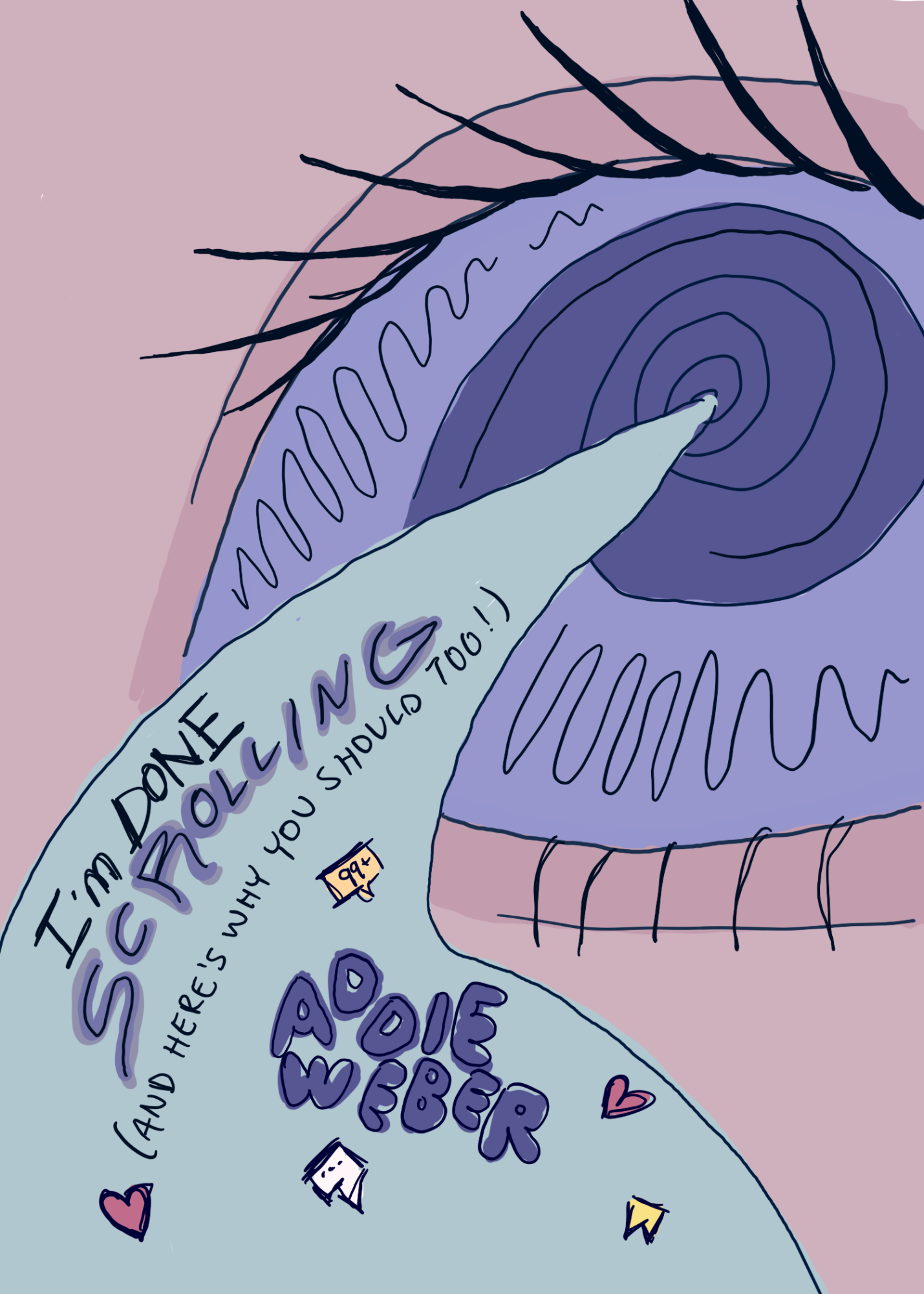
It starts as a quick study break. The day felt long, the sweatpants are comfortable, and you find yourself stretched out on your couch, promising yourself, “I’ll just scroll a little before I start my homework”. But before long, you sink deeper in. And what began as a harmless habit has become a difficult comfort to escape.
For many students, taking breaks after school doesn’t feel or seem harmful. If anything, breaks aren’t actually frowned upon. According to an article published by The University of South Carolina at Chapel Hill, “Contrary to popular belief, taking breaks—if they are the right kind—can actually increase productivity rather than decrease it.”
But is scrolling through social media an effective break, even if a student believes they can maintain enough ‘self-control’ to avoid getting distracted?
It was found that scrolling on your phone can overload your prefrontal cortex, the part of your brain responsible for decision-making and impulse control. Through this overload, where your brain is being asked to make decisions (i.e., what’s happening in this video? Will there be something better if I continue scrolling? Which photos or links should I pause over or click?), addictive behaviors emerge, making you feel less in control, often causing negative emotions.
According to recent studies, teenagers spend several hours a day on social media, significantly impacting psychological distress levels.
The term ‘doomscrolling’ has taken over the internet. It is described as “the compulsive, endless habit of scrolling through negative news, social media, or distressing content on a smartphone, even when it causes anxiety or sadness.” Evidently, the effects linked to ‘doomscrolling’ add up much faster than you might think.
In a 2023 Gallup survey, the average teenager spends about 4.8 hours a day on social media. Through uncontrollable scrolling cycles, hours simultaneously get lost to extremely well-curated feeds, often replacing sleep, homework, and real-life interactions.
What felt like a short break can easily turn into an entire evening gone.
“I’ll see a notification, and the second I pick up my phone, I lose four more hours to just scrolling,” said Zach Wetherbee, a senior at Bellarmine. This behavior wasn’t uncommon for the rest of the interviewees. When asked whether they have “uncontrollable scrolling habits,” several Bellarmine students affirmed, acknowledging that they frequently lose time to “doomscrolling.”
However, it may not actually be your fault that you fell into this cycle. Social media platforms, such as TikTok and Instagram, are carefully designed to keep users engaged for as long as possible.
In an article published by Oxford University Press, one reason social media feeds can lead to addictive behaviors is connected to the gratification theory, an idea that illustrates how certain media can satisfy the user’s needs. If only the user’s relevant needs are met by this medium, the user will continue using the medium.
Features such as endless scrolling, personalized content, and positive feedback through likes and comments create an extremely gratifying cycle that’s difficult to break, even for the most disciplined people.
The more time users spend on these apps, the more content is provided. The more positive feedback they receive, the more validated the user will feel. And it all boils down to the final result: “I just can’t get off.”
But it’s more than just losing time. The science behind constant scrolling is increasingly overlooked and often misunderstood.
Doomscrolling, driven by the brain’s negativity bias, where the limbic system (more specifically, the amygdala) forces focus on threatening information to feel prepared, a leftover fight-or-flight mechanism, creates the familiar addiction-like loop, releasing dopamine for each new update. The dopamine release then triggers cortisol, leading to high anxiety.
Dopamine, the neurotransmitter associated with the brain’s reward circuit, plays a causal role in why users feel glued to their screens. Similar to gambling, the uncertainty of what “shocking news” might appear next triggers a dopamine-driven feedback loop, rewarding the brain for continuing to scroll.
Additionally, through upward social comparison in particular, curated highlights of other people’s lives can trigger an unintentional spiral of comparison, insecurity, and anxiety, leading to feelings of inadequacy and low self-esteem.
Next time you scroll, ask yourself: Is the feeling of “connection” honestly worth a wave of self-doubt?
Despite this, quitting or even cutting back is never as easy as it sounds. With a habit like doomscrolling, it can become harder to focus on schoolwork, conversations, and even simple tasks without reaching for a phone. The constant stimulation makes real life feel slower or even less interesting. And the truth is, social media is built into everyday life.
It’s how we communicate, take on daily tasks, and even entertain ourselves. For students, especially, it can feel almost impossible to disconnect without missing out. But small changes can make a big difference, and it starts with setting boundaries.
Turning off notifications, setting time limits, or putting your phone away during certain parts of the day can help break the cycle. More specifically, keeping phones off nightstands, away from the dinner table, and even switching your phone to greyscale are great ways to reinforce awareness of how often you scroll. The goal isn’t to eliminate social media. Instead, be intentional, be present, and regain control over your life.
If done correctly, social media might force you into something more rewarding than playing “catch-up” on everyone else’s lives. You get to relish yours.